A package might look simple, but getting it right – consistently, at speed, and at scale – takes genuine attention to detail. From the robustness of the materials to the precision of every printed code, every element plays a role. One error on the packaging line can trigger a customer complaint, a costly return, or hit your reputation. In today’s competitive food market, packaging accuracy is a core pillar of product quality and brand trust.
Why packaging accuracy matters
For food Consumer Packaged Goods (CPG) brands, packaging does far more than contain a product. It communicates nutritional information, carries regulatory compliance data, enables supply chain visibility, and increasingly serves as a direct channel to the consumer. Every layer of that packaging – raw material integrity, print quality, label orientation, barcode readability, and data accuracy – must work together.
The consequences of getting it wrong are significant. A misaligned label, an unreadable barcode, an incorrect batch code, or a missing allergen declaration can trigger retailer penalties, product withdrawals, regulatory investigations, and reputational damage. In high-speed, high-volume production environments, even a small error rate compounds quickly into substantial cost. Industry research consistently points to mislabeling and coding errors as a leading cause of product recalls across the food sector.
And yet, many manufacturers still rely on manual checks, fragmented systems, and reactive processes to manage packaging quality.
Every detail counts: the anatomy of packaging accuracy
Packaging accuracy spans several distinct but interconnected dimensions:
An error in any one of these areas is enough to generate a non-conformity. When errors occur downstream – at the distribution center, the retailer, or the consumer – the cost of resolution is exponentially higher than catching the issue at source.
What is a Digital Product Identity?
A Digital Product Identity (DPI) is the digital representation of a physical product, embedded in a 2D code – typically a QR code or a DataMatrix powered by GS1 standards – and connected to trusted, authoritative data sources. It establishes a consistent digital foundation that supports regulatory compliance, traceability, consumer transparency, sustainability reporting, and operational efficiency across markets.
Rather than treating a code on packaging as simply a point-of-sale scanner aid, a DPI approach treats it as a living, linked identity – one that carries verified data, connects to real-time records, and can surface issues at any point in the product lifecycle.
For food manufacturers, this distinction is transformative. A GS1-compliant QR code carrying a GTIN, batch number, and expiry date is the anchor point for end-to-end packaging execution, quality assurance, and traceability.
How DPI addresses packaging accuracy at source
Digital Product Identity enables manufacturers to implement a Packaging Execution System (PES) that provides end-to-end oversight of packaging and marking operations, while maintaining seamless connectivity with ERP and MES systems. This means that the data encoded on the pack is always synchronised with the master record – eliminating the category of error caused by manual re-entry or version mismatches.
A DPI-enabled packaging execution approach allows food companies to:
- Gain real-time visibility across the entire packaging environment, flagging deviations before they become defects
- Centralise the management of all marking activities – printing, verification, counting, and reporting – within a single controlled framework
- Enforce robust user and access management to ensure only approved artwork and data reach the line
- Improve production efficiency and Overall Equipment Effectiveness (OEE) through real-time line monitoring and control
- Identify process bottlenecks and recurring pain points, enabling targeted corrective actions and continuous improvements.
- Maintain accurate and trusted product data, automatically synchronised with enterprise systems
- Enhance quality assurance with automated reporting and validated proof of quality claims
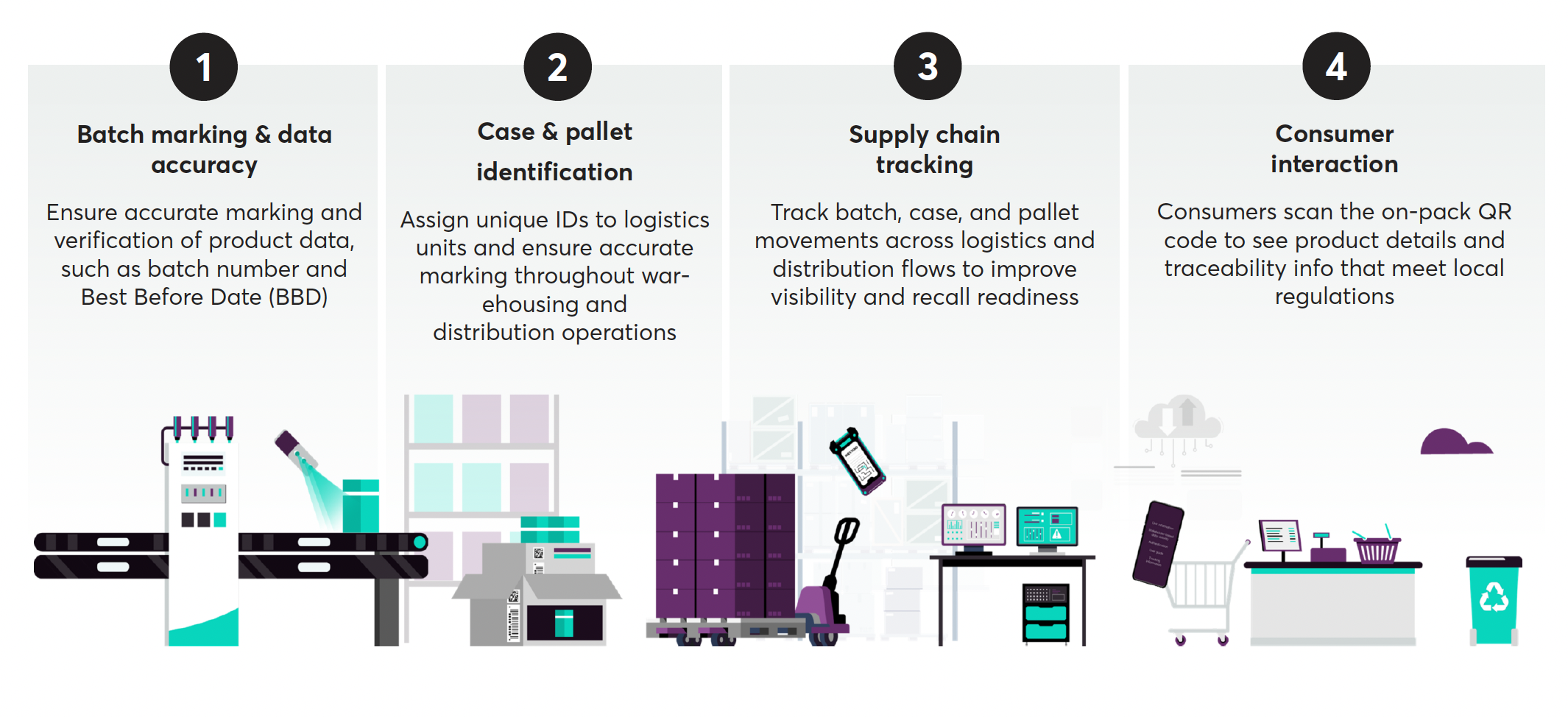
The level of data granularity expected by retailers and regulators today requires that marking happens during the packaging process itself – directly linking each product to its batch number and expiry date. These two elements are critical for logistics management and quality control. Without a batch number embedded in the QR code, a fast and targeted recall is simply not possible.
Traceability: from batch to item level
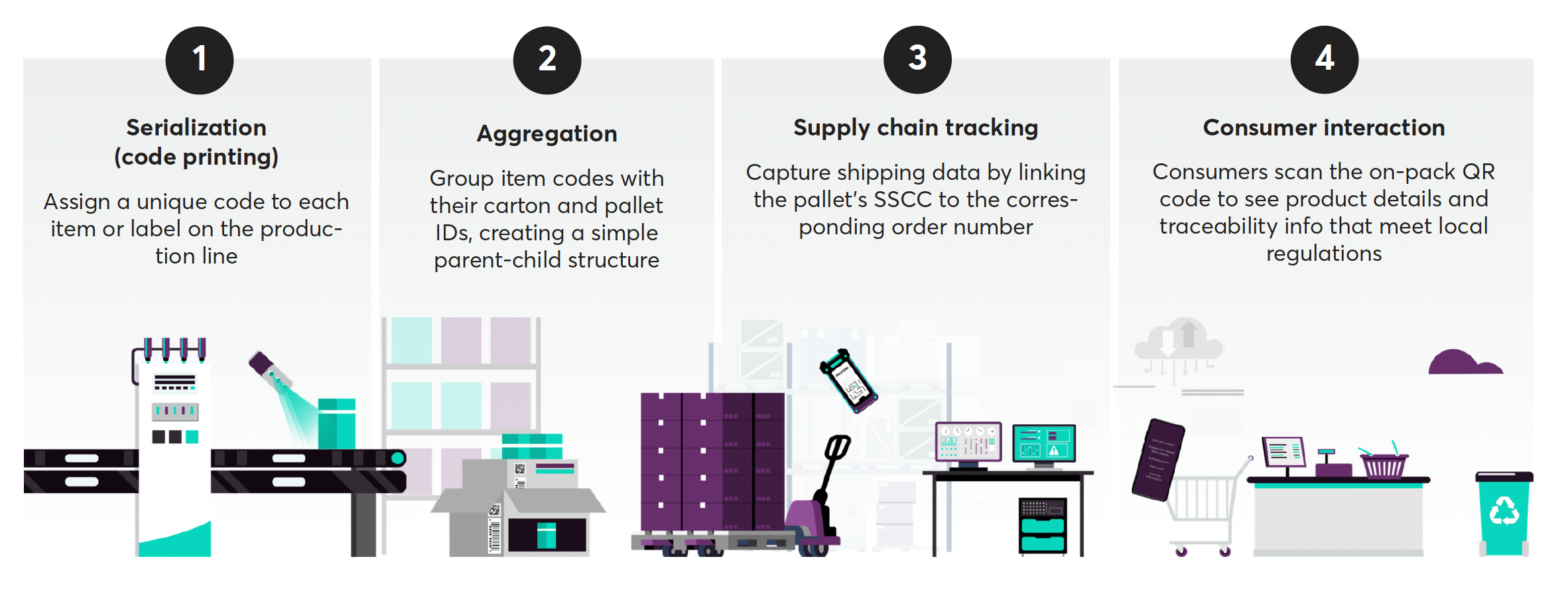
Once a Digital Product Identity is assigned, it becomes the backbone of effective traceability across the supply chain. By linking physical items to trusted digital records, food manufacturers gain visibility and control throughout the product lifecycle. Depending on operational requirements, companies can implement DPI at batch level or item level, each offering different degrees of granularity.
Batch-level traceability provides a foundational level of visibility by linking groups of products produced under the same conditions to shared records. In the food industry, this already delivers significant value:
- Meeting core regulatory traceability requirements
- Ensuring accurate batch marking, including Best Before Date, batch number, and production information
- Enabling faster, more targeted recalls compared to product-wide actions
- Improving internal quality investigations and reporting
Item-level traceability builds on this foundation and unlocks a higher level of precision. Each individual product carries a unique digital identity, enabling information to be captured and retrieved at the item level throughout its lifecycle:
- Highly targeted recalls, limited to only the affected items rather than entire batches
- Granular product histories, including production parameters, dates, locations, and downstream movements
- Improved protection against diversion and grey market activity
- Advanced consumer engagement use cases, including loyalty programmes and item-specific analytics
From compliance requirement to competitive advantage
Packaging accuracy has traditionally been framed as a compliance and risk management concern. That framing remains valid – but it is increasingly incomplete. Brands that embed Digital Product Identity into their packaging operations are not simply reducing error rates. They are building a scalable infrastructure for consumer transparency, sustainability traceability, and omnichannel engagement.
As GS1 Digital Link standards gain adoption and retailers begin mandating 2D codes in place of traditional barcodes – a transition already well underway – the brands that have invested early in DPI-enabled packaging execution will be structurally better positioned. They will have cleaner data, faster recall capabilities, stronger retailer relationships, and a direct channel to their end consumers.
Getting packaging right is, in the end, about getting the product right. In a sector where consumer trust is hard won and easily lost, that level of accuracy is a brand promise.
Ready to strengthen your packaging accuracy?
Discover how Inexto solutions can help your team move from reactive quality management to proactive, data-driven packaging execution.